Skip to content

thinking…

If you’re seeing this, you’re subscribed to the RSS feed or you’ve figured out how to see into my archives.

Today, I added a mostly blank index.html file on asuh.com so that this post isn’t directly accessible on the homepage.

UPDATE 04/2025: I took the file down, still thinking…

I need to think about the value of this site as a personal vessel of data. Part of me is ready to wipe a lot of my digital presence from existence since everything here is basically used to train all the immoral AI and populate LLMs from these companies who didn’t ask for my permission.

I don’t know what I’ll do next. I’m slowly deleting old accounts and data from other online places since it’s unnecessary for them to exist.

I’m not finding joy in writing publicly, either. It’s personal and public documentation, maybe others benefit from time to time, but ultimately it’s my personal value that mainly benefits me.

Let’s see how I feel in the coming days and weeks.

updated the site again

Reached a stopping point to update asuh.com using the new Forage theme I put together.

github.com/asuh/forage/

It’s nice to remove so much from my previous iteration and simply things with some modern CSS.

Forage is such a great tool for classic theme developers and I should continue improving it where I can.

Next, I’m going to probably update another site with Forage that uses Gutenberg and see how that goes. I believe it’ll be a hybrid block theme this way.

it just works

If you visit this website, it’s likely it won’t look or act any differently right now. Maybe you’ll see a new dark mode! I spent the last two weeks moving to a new WordPress theme, one which I’d call a younger cousin to the previous theme I used. It has less under the hood, uses slightly different syntax, but the ideals behind some of the tech are similar.

Here are some small updates I made in the transition:

  • I added a new CSS function called light-dark(), pretty much the result of Dave Rupert’s experiment. You know what this unlocked for me? I was able to remove almost all declarations of color and background-color from the code, outside of a few instances. I couldn’t believe how it simplifies light and dark mode code.
  • I was using CSS mixins to drive fluid sizing, borrowed from this Codepen. This was a Scss based mixin that gave the site fluid responsive superpowers, added around 2017. Since that time, utopia.fyi is now a much easier, more efficient way to provide fluidity. And, I don’t even have to use Scss for this.
  • All variables are now CSS custom properties, aka CSS variables. I love removing abstractions!
  • I have a new plugin called Lite Video Embed, which now won’t require YouTube to load everything until the visitor interacts with the video. Performance win!
  • I’m now using another new CSS function called color-mix(), and it’s pretty badass how it just works. This is another Scss abstraction I didn’t need to use.
  • Switching themes means I transitioned from using Webpack to using Vite. It’s such a refreshing difference!
    • One major difference that I noticed immediately is the ability to run the vite server environment, and allow it to hijack the development environment for reloading.
    • In other words, I don’t need to have two environments to see live reloads anymore. If I’m using https://example.local/ to see WordPress work locally, Vite will use the same environment for live reloading. No need to switch to a different URL like https://localhost:3000! Truly, I’ve been annoyed by this for more than a decade about Webpack! No more!
  • With all of this, I changed every CSS partial from .scss to .css. Since CSS now supports nesting natively, Sass and Scss aren’t necessary for my personal work.
    • Now, that said, this theme does include PostCSS and Vite is still doing some kind of transpiling. I need to figure out how to turn off transpiling and allow Vite to just concatenate all CSS partials into the global CSS file, as well as generate a critical CSS file that I can insert into the <head> for even better performance. UPDATE: fixed transpiling from happening!

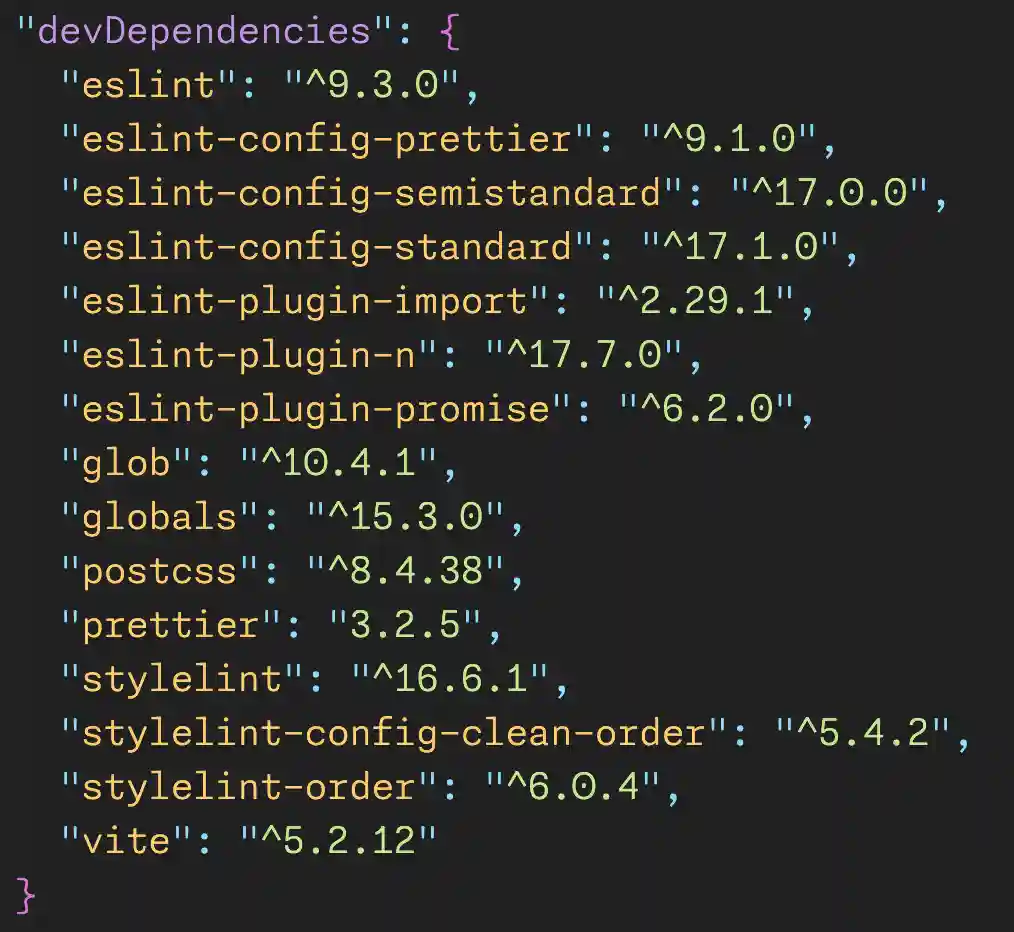
The fact that this new theme has likely half the dependencies that it used to is a big win for me. If I walk away from the theme files and come back in some time, it seems more likely that I won’t encounter legacy issues like I did with Webpack. In fact, here’s what the dependencies look like right now:

asuh.com development package dependences in May 2024 from package.json

I think I might clone the original theme at some point and update it to either remove whatever possible above as well as add back in some of the changes I made for this theme. So my Github might have one more repository before too long!

The takeaway from this work, at least for right now, is that I really enjoy working with Vite. It’s such a cool builder and feels so much easier than anything else I’ve used. I needed this kind of enjoyment with tech since my career has been such a rollercoaster of stress!

Oh, and I hope this automatically syndicates to Mastodon and Bluesky. So that’s another test of posting this.

Vite with WordPress theme

I’ve been on a digital journey this week to prepare for updating my personal site. I haven’t truly updated my site’s theme in so many years that it’s broken to use as is.

So, I decided to search for a similar type of theme, which is Roots Sage theme. When I chose it, it was a fascinating alternative to the type of WordPress themes of the late 2010s. The file organization and progressive nature of tooling and packages was quite attractive to developer me. This came as the expense of letting it sit there and technology changing, with multiple upgrades on my personal machines to disrupt the ability to use the same tooling and tech stack.

That leads me to this week’s priority. Knowing how convoluted Webpack is, it’s a complicated bundler. There are so many additional packages that’ll enhance the experience but add additional overhead for upkeep.

Sage also moved on to a new major version and that team refactored the theme enough that it has at least one or two external dependencies from new repositories. I tried to work with this new architecture a couple of years ago or so and it was just too much.

Knowing I didn’t want to continue with a theme using Webpack, I searched for non-Gutenberg centric themes that includes a newer bundler called Vite. Why Vite and not others like Parcel? Honestly, because Vite seems to have better momentum. And I was able to find plenty of themes using it, most of which are not useful to me.

One stands out and I believe it’s going to work. I can’t remember exactly how I found this theme, and it’s buried in a develop branch, but so far this Footmate Pro theme is working pretty well. There are enough similarities between the Sage theme and this theme that I’m intending a 1:1 transition where possible.

I had a couple of days of issues trying to copy some of the old template file code into this new theme, primarily because using a newer version of Laravel meant new functions are sometimes needed for templates. I temporarily stopped and tried working with a different Vite based WordPress theme, but it was just too outdated to work. I returned to this theme, reviewed Sage’s newest version to review newer Laravel code updates, and applied a newer function that finally fixed the issue. So I believe things shouldn’t be as difficult.

One of the amazing things this theme offers with Vite is the ability to do live page reloading using the same local URL, rather than an additional localhost address. This means that saving an HTML, CSS, or JS file with updated code will immediately update your site at https://example.local rather than needing to use http://localhost:3000. This is a long standing pain point we’ve had using reloading tools!

If this truly works out, I’m going to attempt to keep abstracts to a minimum, and continue to include tools for an indieweb presence. PHP and Laravel will provide server side work, but most client-side code will be plain ‘ole HTML, CSS, and JS.

Beyond this, we’ll see where WordPress fits into everything. I’m evaluating other tooling like Astro and 11ty. I’m ready for a future proof technology that won’t pose huge issues if I have to pause for another amount of time.

typescript, graphql and wordpress

I took a few days to reacquaint myself with GraphQL the last few days. It’s hugely popular with developers as a way to efficiently work with data, providing an efficient way to get a specific set of data to use in a code base. It’s compelling once you understand how to use it.

So I went ahead and installed WPGraphQL, on a WordPress instance I have, to put my feet on the pedals and begin riding. For a few months, I was contemplating creating a custom-built look to a website, and I also wanted to try out using Astro. This was a good opportunity.

It’s trivial to set Astro up, running:

npm create astro@latest

It asks if I want to use TypeScript, so sure, why not. I’m familiar with it, this’ll give me more experience to use it, all it’ll do is take up more time if it’s not easy to put together.

Okay, so then I begin setting up a very simple couple of template files in Astro.

+ src
  + data
    </> wordpress.ts # This is where I fetch the data
  + layouts
    </> default.ts # This is the baseline application wrapper
  + pages
    + blog
      </> [slug].astro # Blog post
    </> index.astro # Blog roll 

Getting to this point wasn’t too difficult, just following the steps and updating to my project. The head scratcher comes from the actual TypeScript that’s required.

Here’s the blog roll code.

---
import	Layout from '../layouts/default.astro';
import { wpquery } from '../data/wordpress';

const data = await wpquery({
	query: `
		query LoadAllPostsExcerpt {
			posts {
				nodes {
					title
					slug
					excerpt
				}
			}
		}
	`,
});
---

<layout title="Test">
	<h1>Posts</h1>

	{
		data.posts.nodes.map((post: any) => {
			return (
				<article class="post-preview">
					<h2>
						<a href={`/blog/${post.slug}`}>{post.title}</a>
					</h2>
					<fragment set:html={post.excerpt}></fragment>
					<a href={`/blog/${post.slug}`}>read post →</a>
				</article>
			)
		}
	)}
</layout>

Here’s the focus of this code: data.posts.nodes.map((post: any) => {...}.

There’s nothing simple in WordPress about declaring a type on various data, like post: any. In my code, I’ve resorted to the data type any so many times it becomes pointless to continue using TypeScript.

So I have looked all over for a solution. It exists, of course, but from what I can see, it’d look something like post: Post after having to add another abstraction to define what is Post. Tedious and silly, if you ask me.

Already using TypeScript is an abstraction, one I’m finding to not be so useful.

With the above said, let me end this with a general headless WordPress confusion. The future of WordPress, clearly, is Gutenberg. However, according to the author of WPGraphQL,

“[…] much of WordPress was built with decoupling in mind, the WP REST API and Gutenberg were not.”

In fact, it’s worse than this for anyone using modern WordPress using Gutenberg.

“Gutenberg didn’t have a server-side registry for blocks. At this time, all blocks in Gutenberg were fully registered in JavaScript, which is not executed or understood by the WordPress server.

This means that unlike Post Types, Taxonomies, Meta, Sidebars, Settings, and other constructs that make up WordPress, Gutenberg blocks don’t adhere to any type of contract with the WordPress server.

This means that the WordPress server knows nothing about blocks. There are no agreements between Gutenberg blocks and other systems in WordPress, or systems trying to interact with WordPress via APIs.

Blocks were practically non-existent as far as the application layer of WordPress was concerned.”

So this means, if I have decided that Block Themes and Full-Site Editing is the future and I want to support it, and I also want to go headless, I’m in for a world of pain.

Are developers truly going to continue supporting or going with WordPress unless/until they fully get on board with Block Themes? I don’t think I can see myself continue with WordPress as it’s moving forward. With its forced use of React for Gutenberg, to the weird ways you have to set data, attributes, styles, or other options, this looks like a complete lock-in to a specific way of building websites. Maybe this is great for some, but I am having major doubts I’ll stick this out for much longer.

blockquote pizzazz

Trying to be more creative and updated my blockquotes to heavily stand out. It’s my freakin’ blog, I might as well try new crazy styles!

indiewebify this site

It’s fun to think I’m back here writing occasionally, but my personal interests to come back here are more broad. Getting back to a website where I control everything is empowering and the ultimate satisfaction. The kickstart to get this point was seeing the potential through a movement called Indieweb. Indieweb principles align with my personal interests as well as the reason I started writing online so many years ago. I’m also burnt out from the effect that social media has on privacy.

Here’s what I’ve already done to asuh.com.

  • A new look, simplified but intricate
  • New blog post formats called Kinds. They mimic what we know from other social media, such as Notes which are similar to Tweets, Articles which are standard blog posts, Reply posts which are the same as Replies anywhere, Photo posts which can be like Insta photos, Bookmarks, Quotes and more! You’ve probably seen multiple posts where I’m trying out the various kinds I’ve mentioned
  • When I make a new blog post here, I can check a box and it’ll create a new Tweet on Twitter. Not only that, but with various other methods, I can now see all the Twitter activity right here on each post. I could theoretically stop going to Twitter.com or Tweetdeck and use this website to participate in Twitter
  • What’s just as important is I have the ability to show other sites that use the same content I’ve posted here. I don’t want to write into the void of another app when I can write what I want here first and syndicate it where I want. Or I can go to Instagram, post a new photo and I can connect my site to grab everything I just posted on Instagram. In other words, I don’t need to just lose the things I’m posting into these other silos of social media
  • You know how you can check in to your location? You post on Facebook or Yelp or Foursquare and share where you are? I was never that interested in this feature but I have the same ability to inform of my location at time of post
  • For sites and apps that allow it, I can now use this site to log into those other sites or apps. The support for this feature is small at the time of writing but the potential is great
  • Performance optimization is an ongoing task, as I introduce more ways to load this site as quickly as possible. I have more work to do but my goal is for site loading to be better than the rest. In fact, I’ve got some pieces put together to make this site perform as good as apps on phones
  • If you look for a post that I’m talking about code, you’ll see that code is now highlighted with a specific color scheme so that it stands out. This will help me to write more technical posts and contribute back to the web community as I discover, learn and grow as a developer

There’s more to add above but I think that’s a good highlight. Now let’s see where I hope to be in the next year.

  • Add a little more color. This is as plain as it gets but I needed a baseline to build upon. This might be slower than I want but I hope to find ways to make the reading and interactive experience more visual
  • Turn asuh.com into what’s called a Progressive Web App. You know how you can download apps in a store? I’m positive you’ve downloaded more than one app, possibly lots of apps, that are sitting on your phone being unused since you downloaded it. Appstore apps are usually pointless now when you can get the same thing using the web, inside a browser. It’s an exciting area to go into
  • Ever since I started posting, I’ve had to come to terms with what I share online being public forever. However, I’m also not willing to share everything for everyone. I’m going to explore ways to share things here that will not be publicly accessible, meaning they’ll probably be encrypted and require some kind of key to access. I think this topic deserves its own post sometime because privacy has become as precious as fine metals like gold; it’s harder to keep things to myself if I decide to share them online
  • I might get my hands dirty enhancing other themes to help other WordPress users connect with a lot of the above features. Maybe I’ll branch out to one of the frameworks/libraries du jour like React.js/Gatsby and get something up there too
  • I’ll continue contributing back to the Indieweb community in whatever ways and time I can make. I think the community still lacks enough turnkey systems to quickly get people up and running in ways that you feel connected on social media and I can increasingly see a path for this in WordPress and other ecosystems. It’s a long journey but one that’s worthwhile
  • More writing! I’m going to find a balance between some technical writing and personal writing here. Maybe I’ll divide the site up more so that the sections are more distinguished from each other. There’s a lot going on for me, less personally but definitely professionally, and I can’t wait to share more

I hope I look back at this and see that I’ve done even more than I wrote above. However, I’ll still be content if I get to even half of this. There’s so much in store for the year and the potential is endless so I hope I can make 2019 an productive year for my personal growth and continue Indiewebifying as much as I can.

the web, my web, and an open web

Being back at asuh.com is satisfying. I’ve started new again, renewing a passion I once had, and I’m excited for things to come.

Before I knew it was probably my career, creating on the Internet (capital ‘I’ at the time) became a new puzzle I enjoyed solving. I spent the late 1990s and early 2000s learning to how to utilize all things digital. I was inspired by friends and industry professionals, seeing how websites gave people freedom and platforms of their own.

I was able to register this domain in 2002 after it was released by someone else who previously purchased it. This is my prized domain name since I feel a connection to the term “asuh” since the early 1990s. For the next few years, it was my digital home and where I expressed myself to broadcast to others, interested to keep up with even a small part of my life.

Things slowly changed in the MySpace days starting around 2007. I posted less here and more there, where the eyeballs and activity were focused. That participation moved over to Facebook in the late 2000s and has more or less stayed there since this year.

2012 was the year my website’s pulse stopped. One last post about my move and life change and I stopped writing. I didn’t have the desire or interest that I used to have since the online collective, all of us who go on the internet (lowercase ‘i’), was locked into social platforms. How could I find motivation to post here anymore when everyone had migrated into the various apps and sites?

Now at the end of 2018, I’m social-media-burnt-out. I’ve all but stopped posting on Facebook and Twitter except now when I post here first. I don’t enjoy the social media participation like I used to and don’t get the same feeling of enjoyment. I lost trust in most of these platforms.

For the last few years, as I’m listening to This Week in Google, I kept hearing of a movement called Indieweb about owning your data and content: taking back the control from the various “silos”. It was appealing, my ears perked up every time I heard it. So in 2017, I finally made an effort to learn more and participate. I finished a first phase of a website redesign on this site, updated existing content, added new pages and content, and now have renewed motivation.

Controlling what I do online is once again my priority. I hope to set an example here and elsewhere showing how to take back control of my online presence. By creating posts like this freely on my website, I once again give back to an open web, one which starts with me and isn’t controlled by other sites or apps.

Maybe this is just a rose-tinted view I get from my own digital bubble, but being back on here gives me an excitement I missed.

personal websites

Read We Should Replace Facebook With Personal Websites by Jason KoeblerJason Koebler

Personal websites and email can replace most of what people like about Facebook—namely the urge to post about their lives online.

I resonate with Jason’s article having been down a similar path. However, I also see another side to this: Facebook et al are simply the next iteration of communication, sharing content that is valuable to people for a moment in time. I know there are people who put a lot of heart into what they share, would love to revisit the things they said or did. I also know many who couldn’t care less to see what they did or thought 10 or 20 years ago.

The reason siloed social media sites are, and will continue to be, popular is because silos have always been effective as a way to connect, be it from newsgroups or AOL of many years ago. I would argue many, if not most, people are only looking for instant gratification and hits of dopamine in what they do as they participate in these sites and apps. Not all need or want the ability to own their own content or understand the value in it.

For those of us who do, our personal websites are the perfect means to control what is out there. I’ve found new motivation to help give those like me the means to take this control back.

Replied to

I intend to continue updating my site with an agenda to use what I’m doing as a basis for new web projects that are all-in-one products for sites to own their own content. It feels like a new frontier!