If you’re seeing this, you’re subscribed to the RSS feed or you’ve figured out how to see into my archives.
Today, I added a mostly blank index.html file on asuh.com so that this post isn’t directly accessible on the homepage.
UPDATE 04/2025: I took the file down, still thinking…
I need to think about the value of this site as a personal vessel of data. Part of me is ready to wipe a lot of my digital presence from existence since everything here is basically used to train all the immoral AI and populate LLMs from these companies who didn’t ask for my permission.
I don’t know what I’ll do next. I’m slowly deleting old accounts and data from other online places since it’s unnecessary for them to exist.
I’m not finding joy in writing publicly, either. It’s personal and public documentation, maybe others benefit from time to time, but ultimately it’s my personal value that mainly benefits me.
Let’s see how I feel in the coming days and weeks.
Let’s talk about the new popover feature added to HTML. I decided to create a few versions of a modal that contains a search form, just to both get experience as well as prove that this is a good new use of a popover. I am biased but I’m completely on board!
Because responsive websites have so many features that need to work from small to large devices, sometimes we have to make decisions that universally provide necessary features but don’t add too much complexity for users. One of those is a search field that can fit on all devices, and it’s this feature that led me in the direction of a modal.
Yeah, I know, modals are overused. They distract from the main content, take focus away from the important parts of site. However, adding a search form to a modal provides a much used feature with minimal impact on mobile layout structure, allowing for more components in a small area.
This is an example of a search component on a mobile sized device with a minimal footprint
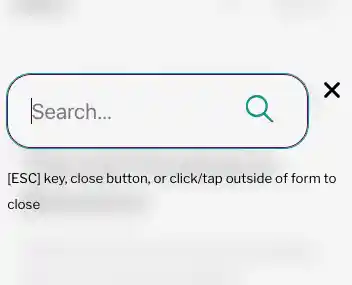
To activate the search form, the magnifying glass icon is a button and requires to be pressed or tapped. A search form appears inside of a modal that overlays the screen, blurring the background.
The search form appears in a modal on top of the content
Since spring of 2024, we have a new feature of HTML, using an attribute, called popover. This new addition to the language provides some really great superpowers:
No javascript required!
Automatic overlay, highest z-index
Light dismiss (clicking/tapping outside of the popover element)
Default focus management
Keyboard binding for improved accessibility support
Support for ::backfill pseudo element (wanna blur the background without extra code!)
If I was talking to my 2000s web designer self, he would describe this as magic! Because, well, it really is so simple and easy.
Because of the above bug, in order to have universal support, I created another version that includes a button inside of the popover that mostly duplicates the button trigger that opens the popover, but instead this one closes and dismisses the popover.
Just to fun, I took one more try at making a version that uses the dialog element, which has been available since 2022. The main reason I did not go this route was to attempt a new, accessible element with no javascript. Buttons that open dialogs have at least one inline onclick="dialog.showModal()" attribute that’s required for the dialog to appear. Adding light dismiss also requires a little script, as you can see in the CodePen example. Additionally, the dialogs don’t need any additional code for focus to just work right, which is very nice.
You have your choice in these examples so feel free to borrow or steal whatever you want!
Twenty Twenty-Five is built as a block theme. The theme aims to ship with as little CSS as possible: our goal is for all theme styles to be configured through theme.json and editable through Global Styles.
This makes me sad.
In a different system, a configuration file like theme.json would be considered a design token where a design system will automatically generate a JSON file full of tokens to be used in a component library or website. The potential for design tokens are quite high, but sadly they’re less practical without tools that are configured to both generate the design token file or system and give easy access for developers to use them. Right now, it’s still piecemeal and there’s not a great workflow in many systems.
Modern WordPress development is abstracting a subset of CSS to a JSON file, for the ease of builders and publishers. The developers who build Block Themes are kind of being forced against the grain of the web in the development phase. Developers consumed by a Javascript-centric system, this might make a lot more sense. But, for those of us who want to build using the technology that browsers provide, this is very unappealing and backwards.
This is just another reason I can’t see how much longer WordPress will be serious going forward. Maybe the update to React 19 in Gutenberg will change things, considering that it makes Web Components a first class integration, also considering the possibility of using React Server Components. But, I haven’t seen anything that gives me an indication either of these are being really thought out.
This isn’t spam, I promise, but I’m spending a little time re-setting up some indieweb services to that I can syndicate new posts to services automatically. But, thanks for reading this message!
I might not be well versed in TypeScript, but I really like this article that goes into using JSDoc as a great alternative to keeping JS but defining types. It provides a lot of easy to understand example and context.
I don’t know if WordPress’ direction with Gutenberg really serves my interests. In fact, what does a world beyond WordPress look like now for this site?
My last system move was from MoveableType to WordPress in 2008. MoveableType was great to get used to CMSes, and WordPress was a huge improvement b/c of the growing community.
In 2024, Gutenberg is the future of WordPress. I’m not enthusiastic about it. Now that HTML, CSS, and JS are making regular strides with first-class APIs and modern upgrades like native Web Components, I’m kind of ready go back to something more native. The thought of development like I did back in the early 2000s is appealing, but with modern content management.
Maybe headless? Maybe all static generated? I don’t know. I’m exploring headless now b/c why not.
I’ll be on WordPress for a while, no doubt, but can I hit 2025 with something new here? or at least different? Who knows. Life is busy!
I’ve been using Mastodon, lightly, for most of the year. It’s where the most relevant chatter was since Twitter’s fracture.
By a miracle, and help from OldTweetdeck, I’m still running the previous version of Tweetdeck for now. It’s on life-support and could die at any time.
Besides the light use of Facebook and Instagram, and having signed up for Pixelfed but not really using it, it’s a weird time for social media in 2023.
To recap:
Twitter is dying. Its owners want it to be called ? but nah, not gonna do that
Tweetdeck still serves its purpose for me, a general idea of what Twitter people are saying, but it’s far more conservative hyperbole now. However, still my #1 social attention spend
Facebook serves people older than 30 crowd just fine, I guess, but I am allergic to its slurping up of all data to do who knows what. No thanks
Instagram is barely useful, mostly for the Stories feature, but just not much to enjoy beyond that
I wanted Pixelfed to replace Instagram, giving me control back, but I just haven’t committed
Mastodon is the 2nd primary attention and most of my posts, which still isn’t a lot
Nostr, well, is really so niche right now, you probably haven’t heard of it. But, for the few notable people I see there, and can’t really see elsewhere, it’s slightly interesting
Bluesky is not really gonna be much for me until I get a Tweetdeck like instant feed refresh tool. I don’t like manually refreshing Bluesky to see new posts, never did about Twitter, eithe
I won’t bother with any other social networks. It’s already too much for me.
Ideally, when magical time and effort appear in my life, I’ll set this site up to just blast out to half the list up there, Indieweb style, and start writing here on this site. Or not. It’s a lot of work, and the UI for WordPress and Gutenberg is not ideal, whether with Classic Editor or Gutenberg.
Also, I still have trust issues with the web in general. OpenAI, ChatGPT, all these new 2023 AI services, this site and my content on all the sites above and more have fed into their dataset. It’s annoying.